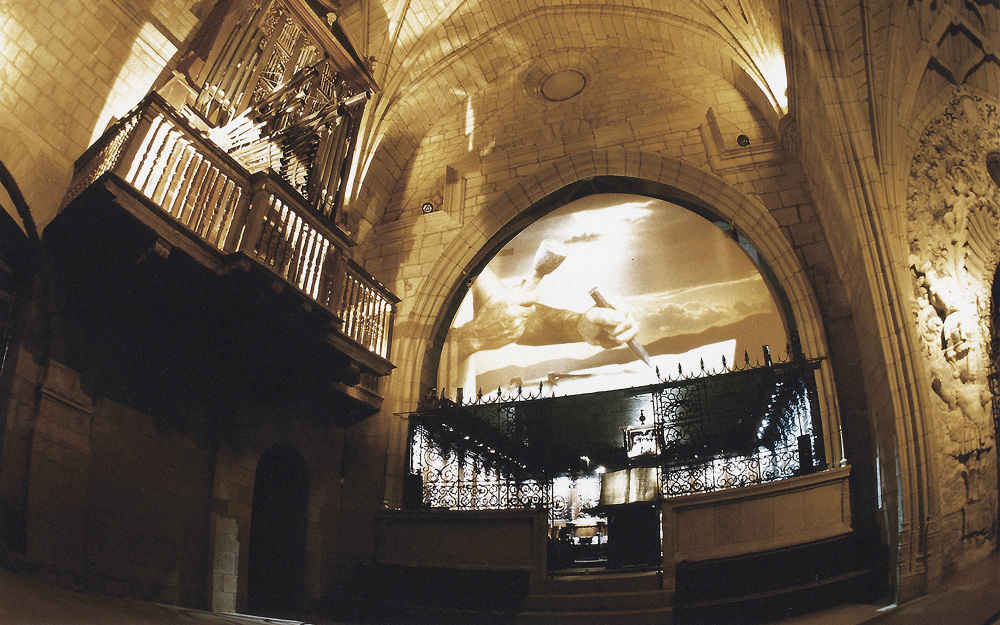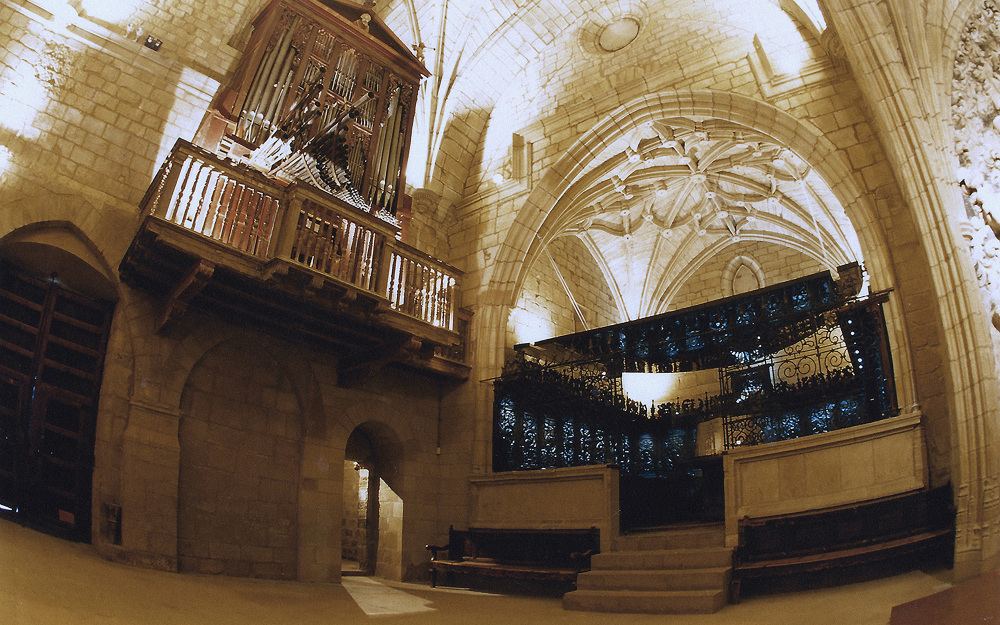

The Church of San Martín de Tours was consecrated in 1179 and extensively renovated in the mid-16th century. One of its most important features is the choir stalls, carved by Juan Picart between 1554 and 1556: a walnut ensemble with reliefs, misericords and medallions, enclosed by a wrought-iron screen and crowned by the organ.
The project had to tell the story of the space through projection while integrating the intervention into a protected historic building where any new addition had to be reversible. A conventional screen would have concealed precisely the heritage that the audiovisual narrative was intended to reveal.
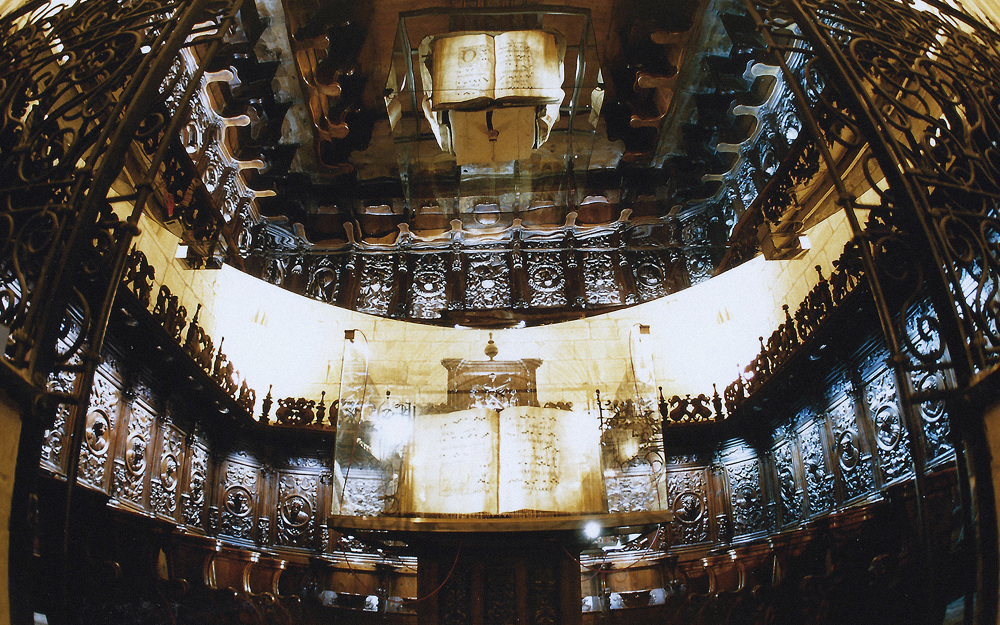
The solution was to conceive the screen itself as a site-specific installation: a large tilting plane suspended within the pointed arch opening onto the choir. In its vertical position, it serves as the projection surface. At the end of the audiovisual sequence, the screen descends into a horizontal position above the choir stalls, while its reflective reverse becomes an overhead mirror.
This movement changes the perception of the space. From within the choir, Picart’s carving can only be seen in fragments and from oblique angles. The mirror makes it possible to see the ensemble from above for the first time. The same device therefore performs two successive functions: it first constructs the audiovisual narrative and then reveals the heritage from a viewpoint that the architecture itself does not provide.
The screen also establishes a spatial and temporal rhythm. During the projection, it visually closes the arch and focuses attention on the narrative; as it descends, the architecture reappears and the visitor’s gaze shifts towards the actual choir stalls and their reflection. The transformation of the device becomes part of the dramaturgy of the visit.
Twenty-seven years after its installation, the system remains in use. The project has since been completely modernised with a new audiovisual production, sound, lighting and digital control, while the original tilting screen has been retained. It is the only element of the original installation that remains in operation.
Concept and design: Ignasi Cristià
Production: Konic Audiovisuals
Photography: Konic Audiovisuals