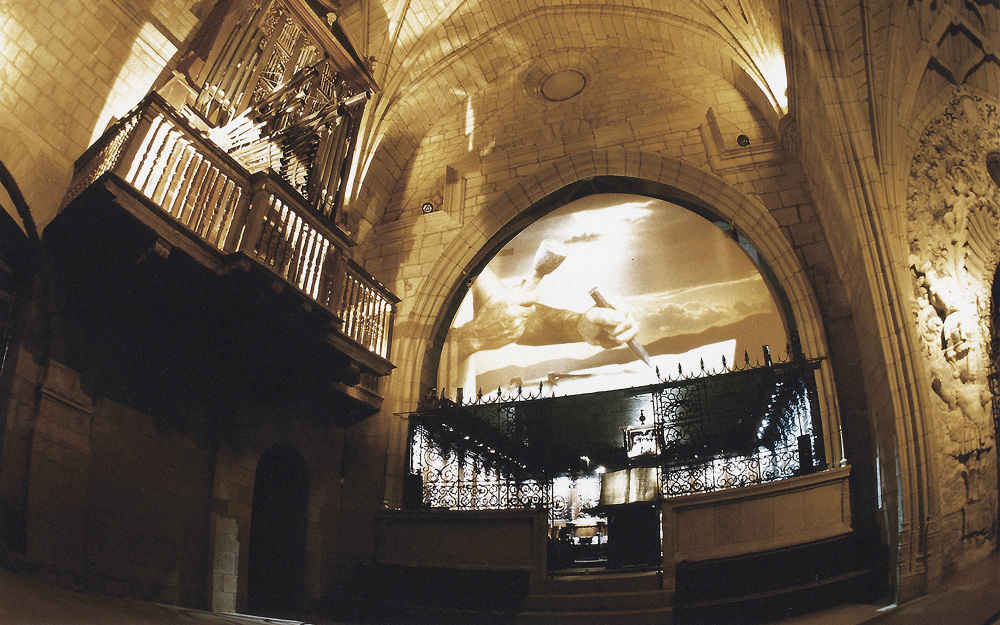

An audiovisual installation inside a protected space: the screen integrates completely into the architecture and builds a narrative with it.
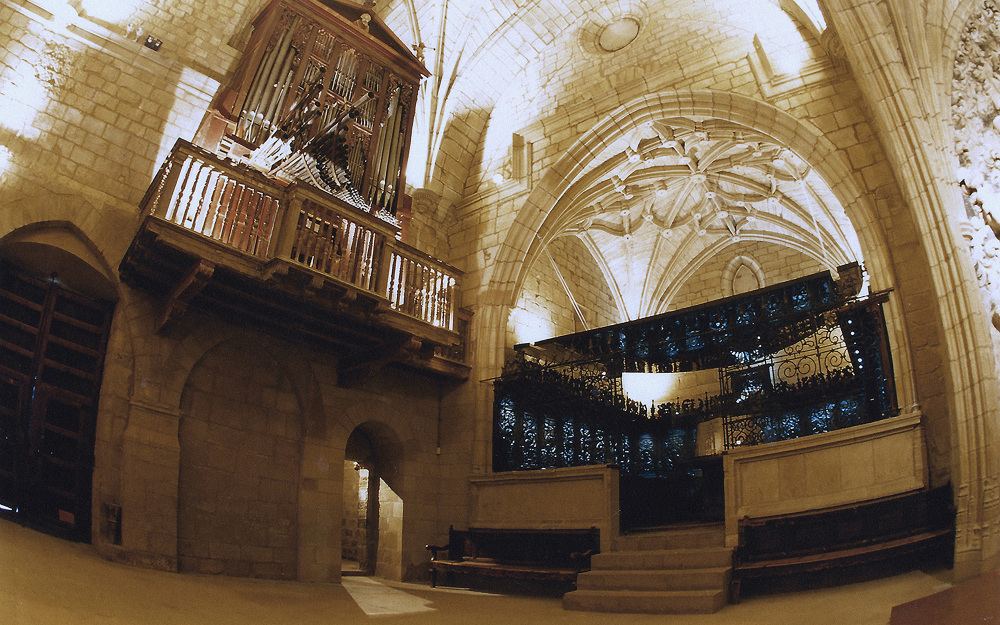
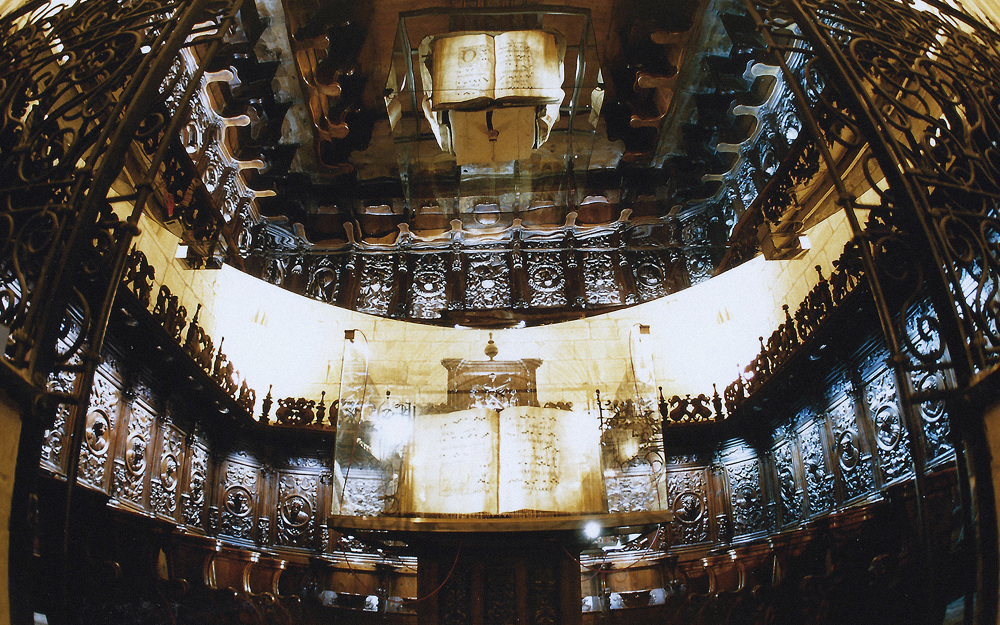
The church of San Martín de Tours was consecrated in 1179 and thoroughly remodelled in the mid-sixteenth century. Its treasure is the choir stalls, carved by Juan Picart between 1554 and 1556: a thicket of walnut reliefs, misericords and medallions, enclosed by a wrought iron screen and crowned by the organ.
The history of the space had to be told through a projection. The problem was clear from day one: nothing can be added to a protected church, and any fixed screen would have concealed precisely what the church had to tell. The solution was a pivoting screen, conceived as an artwork in its own right, suspended within the pointed arch that opens onto the choir. Raised, it is the projection surface for the show. Lowered, it becomes the ceiling of the choir stalls: its reflective underside acts as an overhead mirror above Picart's carving. This changes what the visitor can see. From inside the choir, the stalls read only in fragments and in sharp foreshortening — never whole, never from above. Reflected, they do. The device has two functions and sets a rhythm during and after the show: it tells a story, and it reveals the woodwork from a viewpoint that without it would be impossible.
Twenty-seven years later it is still in use. The installation was fully modernised — new audiovisual production, sound, lighting, digital control — and the screen was kept. It is the only original element still in operation.
Concept and design: Ignasi Cristià. Production: Konic Audiovisuals. Photographs: Konic Audiovisuals.